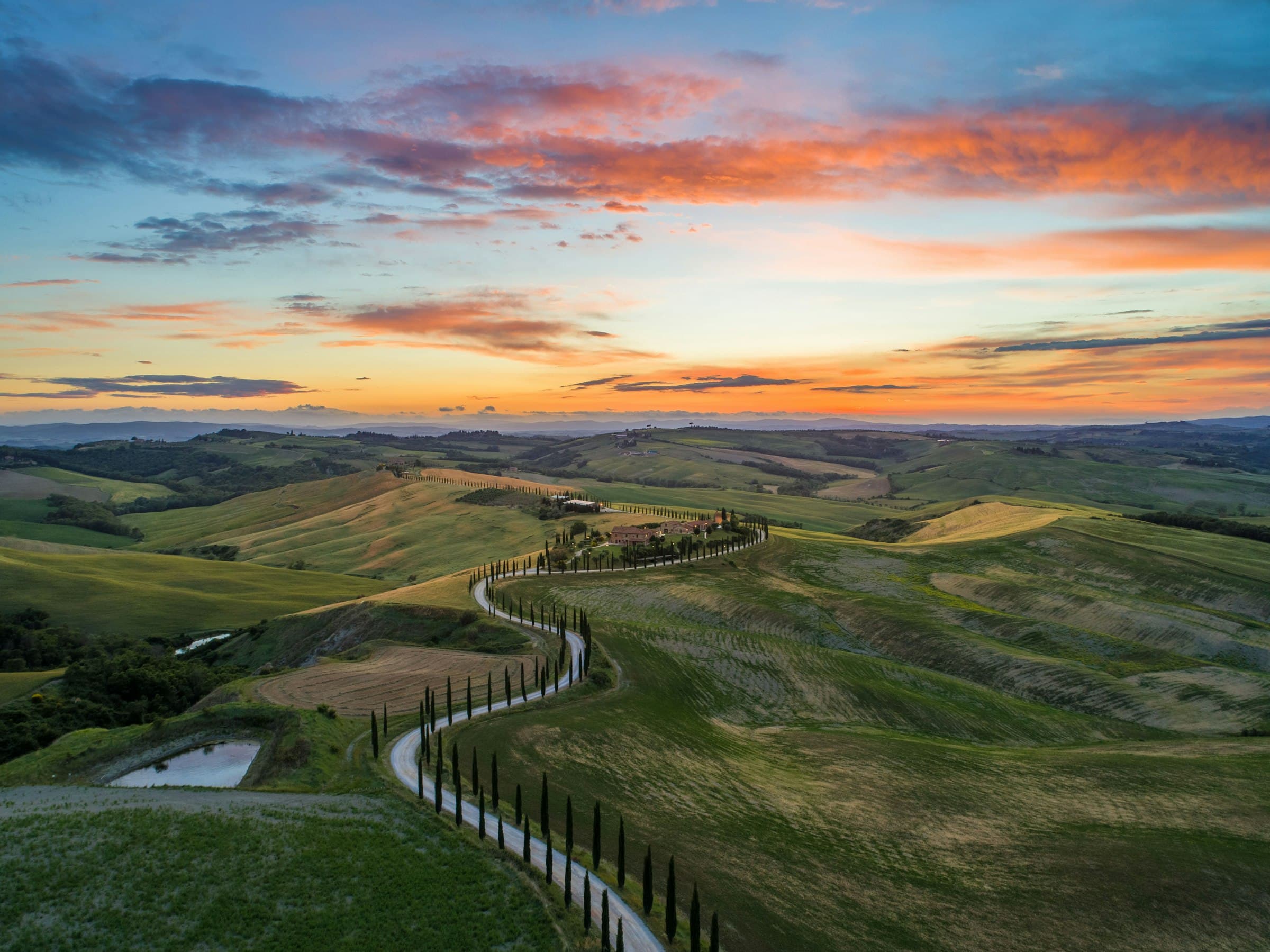
Tuscany has a tourist version, and it is not a bad one — the cypresses really are that good, the wine really is that easy to drink. But there is a quieter Tuscany that Florentines and Sienese still keep mostly to themselves, and it is the only one worth building a week around.
Where to actually base yourself
Skip San Gimignano and Montepulciano as bases — they are gorgeous and they empty out at 6 p.m. when the day-trippers leave, but the towns themselves shut down with them. Florentines who go to the country every weekend pick three places instead: a hilltop borgo near Greve in Chianti, a stone farmhouse in the Val d'Orcia (Pienza, Montalcino, Castelmuzio are all good anchors), or a converted casale in the Maremma if you want to add a coast day.
Stay one place. Tuscany is small but the roads are slow, and the country opens up only when you stop driving past it. Five nights in one casale beats a different town every night, every time.
Book a place with a kitchen. Half the pleasure of a Tuscan week is the morning trip to the alimentari — a small shop run by someone whose grandfather opened it — and a slow lunch on the terrace afterwards. You will eat better at home most days than you will in any restaurant.
Eating like a Florentine
Florentine food is not the soft pasta tourists expect. It is bread (often saltless and dense), beans, slow-cooked beef, peppery olive oil that is barely a month old at the start of November. Order ribollita, pappa al pomodoro, peposo, bistecca alla fiorentina — and order it at a trattoria that has eight tables and one menu printed on a sheet of paper.
Lunch is the meal that matters. Tuscans eat the bigger meal at one and the smaller one at eight. Reverse your habits. Drink wine at lunch — half a litre of the house red, never bottled — then take an hour to do nothing afterwards.
Three places worth a drive: La Bottega di Pienza for cheese and a glass of red at the counter; Osteria di Passignano outside Florence for one proper Sunday lunch with the Antinori vineyard at the windows; and Trattoria Da Padellina in Strada in Chianti for the best bistecca per euro in the region. None will be on a tour-bus list.
The wine drives that locals actually do
The Chianti Classico tour your hotel will sell you is real, but it is the warm-up. The drive Florentines do on a Sunday is north of Greve, on the SR222 between Panzano and Castellina, with three or four stops at small producers who do not always have signs. Call ahead. Most will pour you a glass for free; many will sell you a case for less than you would pay in Florence.
If you have a second day for wine, push south to Montalcino for Brunello. The big estates (Banfi, Biondi-Santi) do polished tastings; the smaller ones (Pian dell'Orino, Caparzo, Ciacci Piccolomini) will pour you something extraordinary in a kitchen that smells of lunch. Ask the owner to taste outside the lineup. They will say yes more often than not.
Drive home through Pienza at sunset. The light hits the cathedral facade for ten minutes a night and the street stops to look. Buy a wedge of pecorino di Pienza on the way out.
Slow afternoons, properly
Tuscany rewards the part of the day most travellers waste. The hours between three and seven — too late for the morning sights, too early for dinner — are when the country is at its best. Walk a strada bianca (an unpaved farm road) for an hour. Sit in a piazza with a coffee. Do not, under any circumstances, drive somewhere new.
Pick one big sight, not three. The Crete Senesi south of Siena, walked rather than driven. A morning at the Abbey of Sant'Antimo, with the monks chanting Lauds at 6:30 a.m. The Saturday market at Castelnuovo Berardenga, where farmers from twenty kilometres around bring what they have. One of these per day is enough.
Florence, in small doses
Most Tuscan trips start or end with a couple of nights in Florence. Two is the right number. The city is dense, hot in summer, and easier to love when you have not exhausted yourself in it.
Book the Uffizi for the first slot of the morning, ideally a Wednesday. Walk Oltrarno in the afternoon and have an aperitivo at Le Volpi e l'Uva or Il Santino. Eat dinner at Trattoria Cibrèo or — if you can get in — at the eight-seat counter at Cibreino. End the night with a gelato at La Carraia, leaning on the bridge.
Skip the Duomo climb. The view from Piazzale Michelangelo, twenty minutes' walk from the centre, is better and free.
What to skip
The Chianti coach tour. Always.
Renting an apartment in central Florence in August. The heat is real; the casale half an hour outside is twenty degrees cooler.
Truffle hunts that cost €300 a head. The truffle is not the experience; the dog is. Go to San Miniato in November instead and watch the actual truffle market.
The temptation to add Cinque Terre to a Tuscan week. It is in Liguria, four hours away, and ruins the rhythm of the trip you came for.
Ready to plan yours?